
By Yohani Gwangway
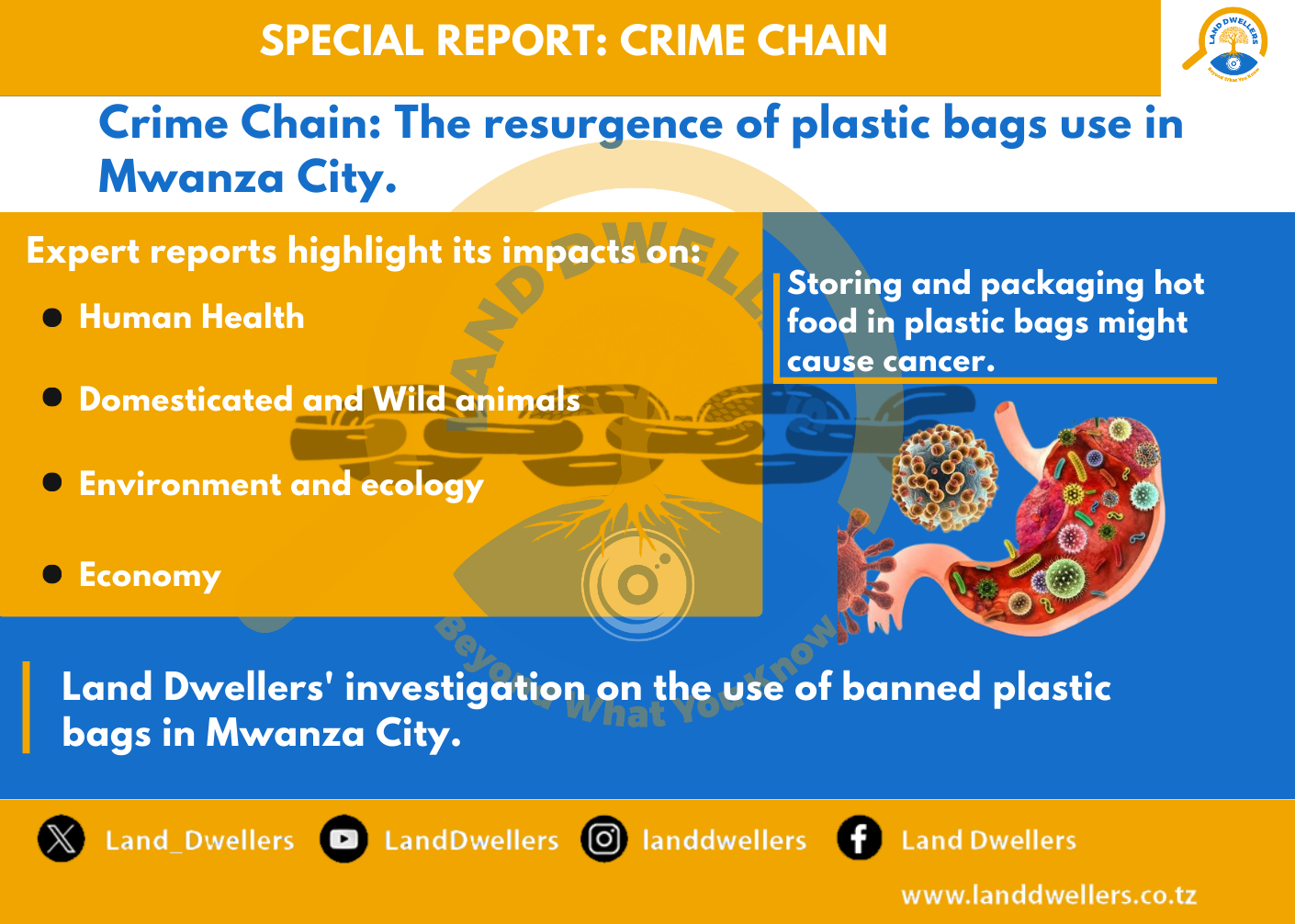
Five years after the ban on the production, distribution, sale and use of plastic bags in Tanzania, the journey has had its ups and downs. When the ban was announced in 2019 and later reinforced with regulations the same year, the public strongly responded by abandoning the use of plastic bags.
However, the use of plastic bags has resurfaced and is rapidly growing. The key question is, why now? In this second episode, we will explore the reasons behind the failure to enforce the government’s 2019 plastic bag ban and its regulations, including the 2022 amendments. We will also examine those responsible for enforcement, the existing loopholes, and the negligence that has allowed plastic bag usage to persist.
Some citizens who use these bags seem to have little awareness of the specific types that have been banned and the consequences of using plastic bags. The lack of awareness seems to be one of the reasons why people are still using them.
“Environment officers are not regularly visiting our neighborhood. But if they worked closely with the people, I believe the issue of plastic bag would have been completely resolved. For example, personally, I don’t recall ever meeting an officer explaining the negative effects of these transparent plastic bags or even their impact on the environment” said Rajabu, a resident of Mwanza.
According to Rajabu, local environment officers are not adequately fulfilling their duties, sometimes are hardly known in the community. This makes the fight against plastic bags even more difficult.
Despite The Environmental Management Act (2004), mandates oversight down to the local level, Tyson Cosmas, a resident of Mwanza, said that for three years he has never seen environment officers in their neighborhood.
“Since I’ve been here, I’ve never seen them. And honestly, I don’t think they are fulfilling their duties properly. These are issues that require education in the community, but we’ve never even seen them provide any education or say anything. So, we just continue using these bags.” Tyson explained how unaccountable local environment officers are.
Education appears to be the main concern for most citizens, while for a few, economic factors play a role. Ahmed (a pseudo name) is a distributor. He distributes plastic bags due to his poor living conditions and a lack of capital to engage in other legal work.
“Perhaps I should say one thing, based on my life and circumstances, honestly, I had no plan for this business. Later, someone told me that, if I deal with plastic bags business, I will make money.” Ahmed explained the reason he started selling plastic bags.
Negligence and corruption among some police officers and regulatory authorities make it hard to control the use of plastic bags. Ahmed said that when he is caught by the police, he is asked to pay a bribe starting from Fifty thousand Tanzanian shillings to be set free. And sometimes, when he doesn’t have such amount, he leaves the plastic bags with the police officers or local guards, who sell the bags themselves.
“Mostly, it’s the police officers and the local guards who make the arrests. There are those police officers who don’t wear uniforms, they are the ones who make the arrests. If they catch you, you just negotiate, you give them money, they leave. If you don’t pay, they take your goods and sell them.” Ahmed explained about the police arrests.
The issue of corruption, which seems to undermine accountability and reduce efforts to prevent the use of plastic bags, has escalated to the point where police officers expect a specific amount of money to release distributors. According to Ahmed, any amount less than Fifty thousand Tanzanian shillings is not accepted.
“To be released, you might have to give more than Fifty thousand Tanzanian shillings, and if the load is small, it’s better to just leave it. For example, if it’s 25 pieces, it’s better to just leave it them.” Ahmed said.
The question is, if the distribution of these plastic bags appears to be a source of income for some of law enforcers, when will there be accountability?
Although there are corruption allegations that involve some police officers, Land Dwellers reached Mwanza Police Force for the answer, but they did not respond.
As we are trying to understand the efforts being made by the Mwanza City Council in enforcing the law, which also have the responsibilities for providing education to the communities. Audiphace Sabbo, a Health Officer in Mwanza City said that the due to the high level of interaction among people in Mwanza, education is required to be conducted frequently.
“As I mentioned, the interaction of people in our municipal is high, so education needs to be prioritized. Today, you can educate people on how harmful plastic bags are, and they fully understand, but after two or three days, you find other people who are completely different from those you educated. Therefore, as the Mwanza City Council, we provide education a continuously” said Audiphace Sabbo, Health Officer in Mwanza City.
National Environment Management Council (NEMC)
According to Environmental Management Act (2004), the National Environmental Management Council has significant responsibilities in managing and conserving the environment. One of its tasks is to provide education to the public. Given the public’s concern about a lack of education, Land Dwellers wanted to understand how the council attains its legal duties.
“NEMC has done a lot, and the first thing is education. So, the first step is to educate people about what packaging is, or which plastic products are allowed and why they are allowed. The second is to educate about the harms and so on. In terms of education, we have set up stations, for example, if you go to Dar es Salaam airport, you will find our staff, but also signs for incoming visitors, so they know that these items are not allowed.” Jarome Kayombo, NEMC Manager in Lake Victoria Zone.
Although NEMC claims to be educating the public about the negative impacts of plastic bags, the reality in Mwanza City is that citizens still have limited understanding of this issue. James Elisante Makondeko, a resident of Mabatini, Mwanza said that in the area where he lives, they have never got any education about plastic bags and their impacts.
“I have never seen education being given about the negative impacts of plastic bags. The only thing I know is that the banned ones are the other types (like Marlboro), but this one here (the white one) we continue to use.” James said, without realizing that even the white ones he is referring to, are also banned.
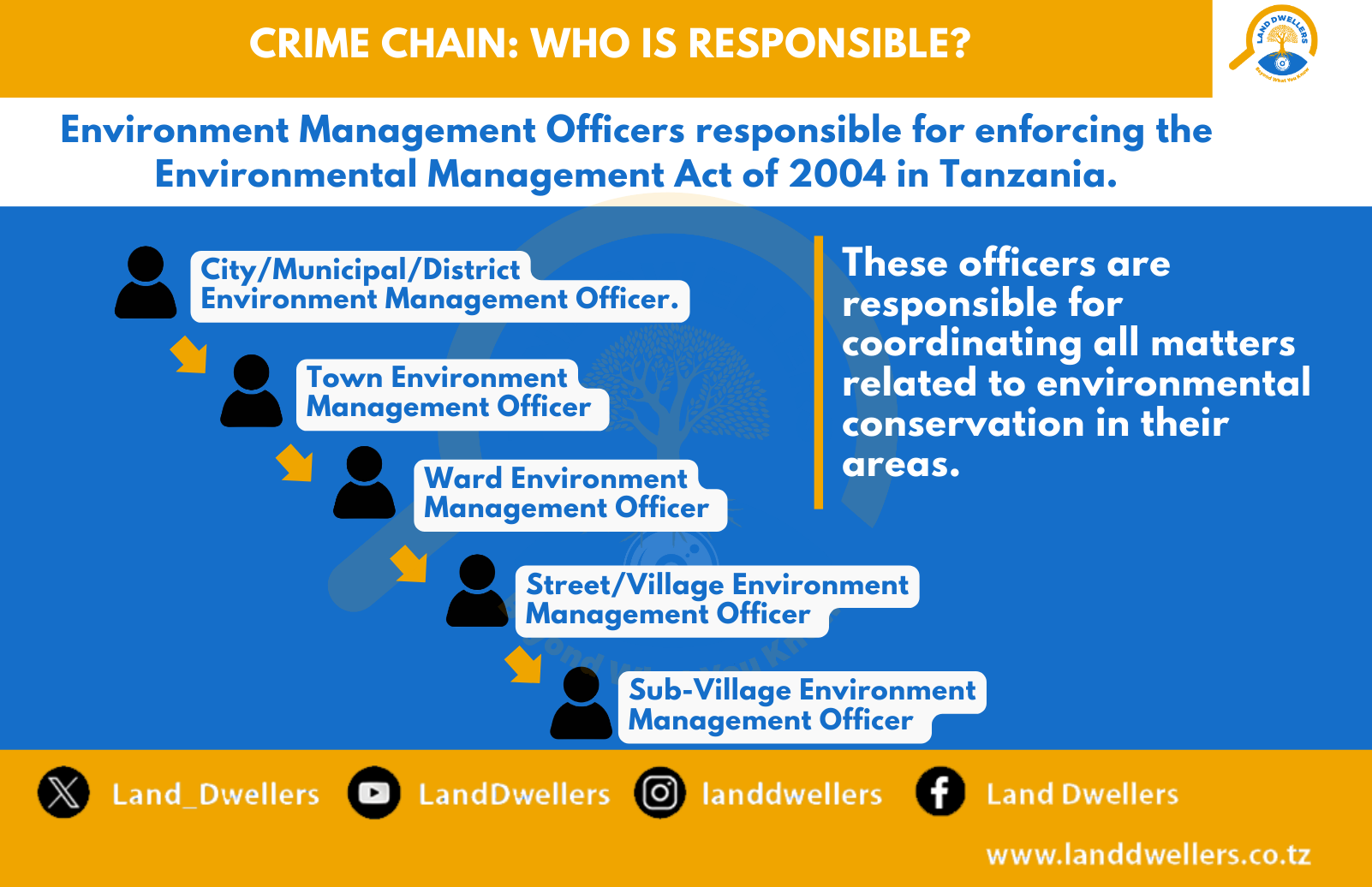
The law governing environmental issues in Tanzania is the Environmental Management Act of 2004. This law largely provides the framework for the implementing authorities and their officers. Sections 35, 36, 37, and 38 outline the authorities responsible for enforcing this law and its regulations. Among those mentioned are the City Environment Officer, the Town Environment Officer, the Ward Environment Officer, and other officers down to the local level.
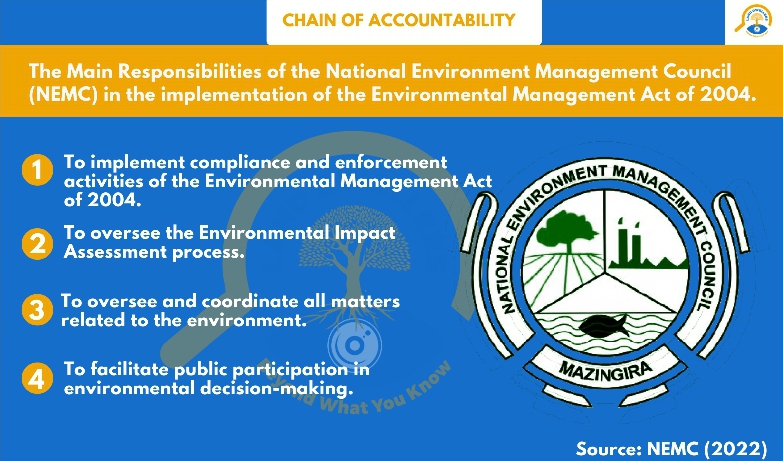
This law also includes Sections 16, 17, and 18, which discuss the establishment, objectives, and functions of the National Environmental Management Council (NEMC).
The purpose of establishing the National Environmental Management Council (NEMC), as outlined in Section 17(1), is to manage regulation, implementation, compliance, review, and enhancement of environmental impact assessments. This will facilitate public participation in environmental decision-making, implement overall management, and coordinate all environmental matters directed to the council under this law or other laws enacted by Parliament.
The National Environmental Management Council (NEMC) plays a huge role in the implementation of laws and regulations passed in Tanzania. However, the council does not have officers in every area, which makes management a difficult task for them. NEMC Manager in Lake Victoria Zone, which oversees six regions, said that the council has fewer than 300 employees nationwide, so it heavily relies on collaboration with other institutions to carry out its responsibilities.
“It’s not that I’m defending myself, I just want to explain the reality. I’ve said that NEMC has fewer than 300 employees in total. In the Lake Victoria Zone, which covers six regions, we have only 23 employees, so even if we divide that, it’s just four employees per region. How can they be present in Misungwi, Magu, or Kwimba? It’s impossible. That’s why our plea is that every Tanzanian should wake up and realize that the environment belongs to them.” Kayombo explained.
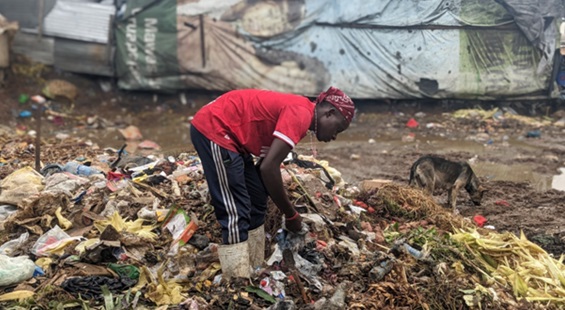
Apart from Environmental Management Council (NEMC), the Environmental Management Act of 2004 recognizes the presence of the environmental experts in each region, who are responsible for advising on environmental matters within the respective region. However, based on the feedback provided by citizens regarding environmental management in their areas, it appears these individuals are not reaching the community.
Environmental officers in the respective areas
The law recognizes the presence of environment officers at the district, town, ward, village, and sub-village levels. These are environment management officers, some of whom are environmental experts have the responsibility of advising on how environmental management should be carried out in their areas.
The responsibilities of these environment management officers are outlined in Section 40 of the Environmental Management Act of 2004.
“The duties of the Environment Management Officer at the City, Ward, Village, Street and Sub-village levels will be to coordinate all tasks and activities aimed at preserving the environment within the city, ward, street, village, and sub-village, or as far as it extends within the district of the respective area” states the law.
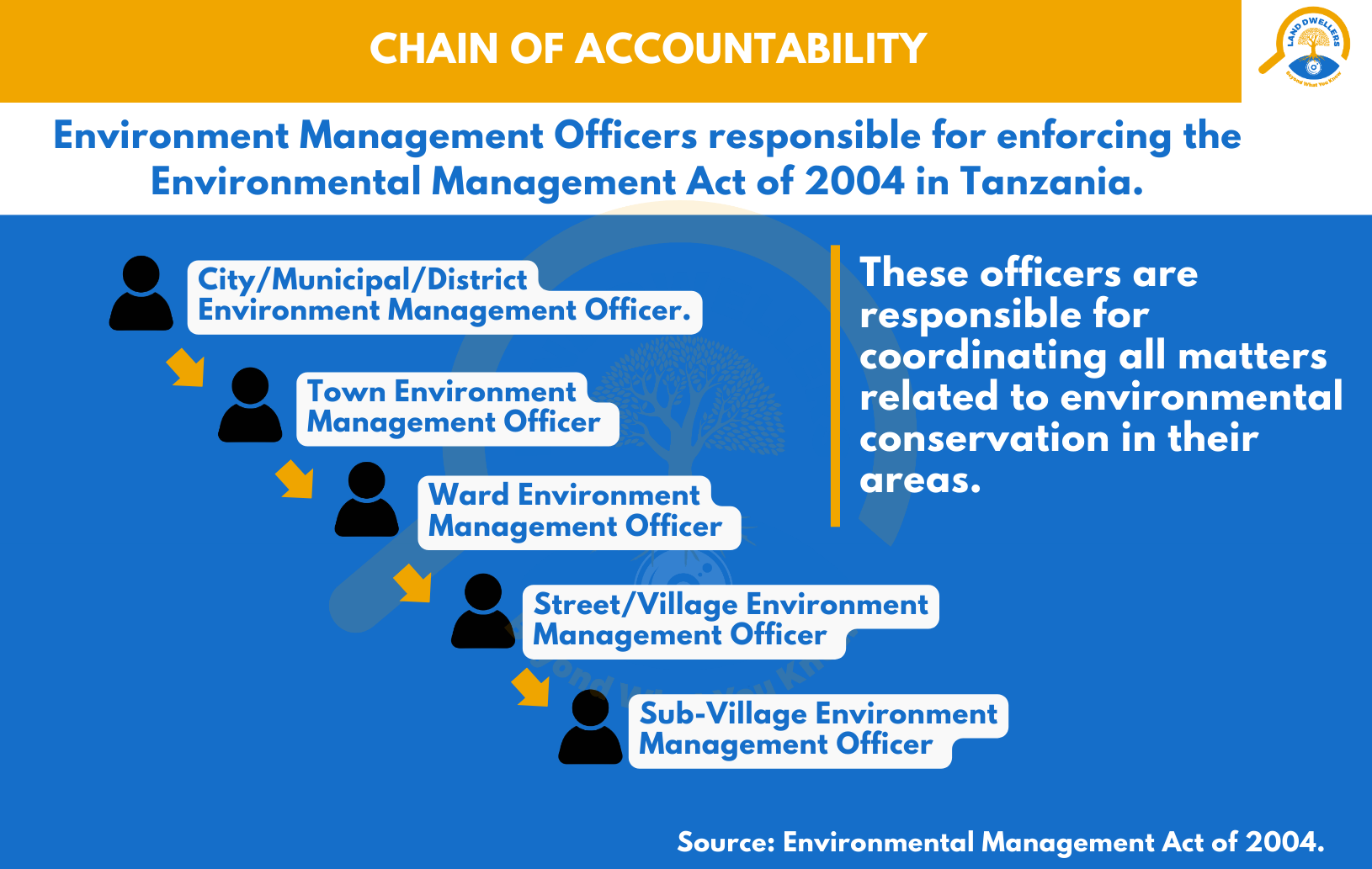
The widespread use of plastic bags in the streets raises questions about the accountability of these officers. Do they perform their duties properly? The NEMC Manager in Lake Victoria Zone said that, if everyone were responsible, the enforcement of the plastic bag ban in Tanzania could have been much more successful.
“The law states that at the regional level, there should be an environmental expert, that is, a Regional Environmental Management Expert, and at the district level, there should be an environment officer. If you go to the ward and street levels, there are environmental committees. So, looking at the law, the system is clear. If these people were doing their work, there wouldn’t be plastic bags.” explained Kayombo, NEMC Manager in Lake Victoria Zone.
While NEMC explains the responsibilities of environment officers and experts in various areas, the Acting Head of the Environmental Sanitation Department in Mwanza City, Desderius Polle, explains that they have been collaborating with various stakeholders, including market leaders and the government.
“We collaborate with the ward leadership, we work with the ward health officers, and we collaborate with the market chairpersons to receive information if there is anything going against environmental sanitation. They are the first ambassadors to report, and we take a quick action. So, the collaboration is strong, just as the system is” said Desderius Polle, Acting Head of the Environmental Sanitation Department in Mwanza City.
In this investigation, it is clear that environment officers are not being mentioned, especially at the local levels, and instead, health officers are being referred to, which is contrary to the Environmental Management Act of 2004.
The Standing Committee on Urban Planning and Environment
Section 37(1) of the Environmental Management Act (2004) addresses two key committees responsible for managing environmental issues. These committees are the Standing Committee on Urban Planning and Environment, which was established under Section (1) of Section 42 of the Local Government (Urban Authorities) Act of 1982, and the Standing Committee on Economic Affairs, Construction and Environment, which was established under Section (1) of Section 74 of the Local Government (District Authorities) Act of 1982.
These committees have several responsibilities that are legally outlined. The Section 41 of the Environmental Management Act (2004) lists the duties of the Environmental Management Committees at the City, Municipal, District, Town, Ward, Village, Street, and Sub-village levels.
Each Environmental Management Committee established on a particular area shall have the authority to;
Among the responsibilities of these committees are to initiate investigations and inquiries into any environmental-related allegations and the implementation or violation of the provisions of this law, demanding any person to provide information or details on any matter related to the environment, and resolving conflicts between individuals, companies, agencies, non-governmental organizations, government departments, or agencies regarding their duties, functions, capacity, responsibilities, or activities under this law.
Other responsibilities include inspecting and investigating residences, streets, vehicles, airplanes or any other location or item believed to be a pollutant, or where there is reasonable cause to believe that pollutants or other substances are being stored or transported. Requiring any person to remove at their own expense any item or substance to any location believed to be a place where such items or substances can be safely stored or disposed of without causing harm to health. Filing civil or criminal cases against any individual, company, agency, department or organization that fails or refuses to comply with any order.
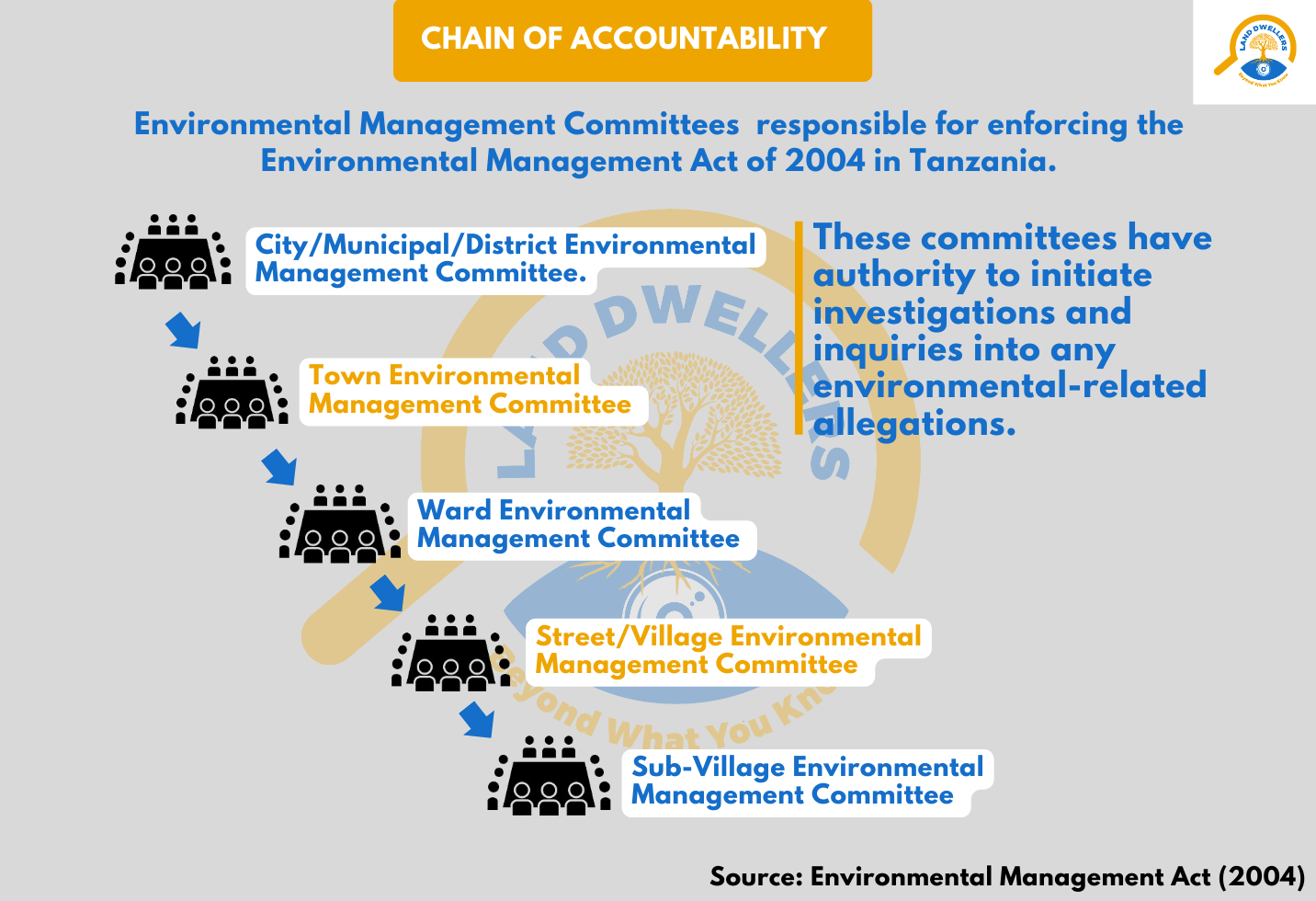
Despite these responsibilities, Land Dwellers investigation discovered that these committees are not given priority and they do not meet regularly to set environmental management plans on their areas. We visited three sub-villages and two streets, where we spoke to some members of these committees. Although they were not willing to disclose their names or locations, they shared the challenges faced by these committees in their areas.
Among the issues raised were the lack plans by these committees, leading them to wait for the breaking of laws before they appear to take action. The absence of strategies poses challenges in doing their responsibilities.
“The committee exists, but it is not given any priority. The committee members don’t even know their responsibilities. It is very rare for us to plan environmental strategies. It feels like it works at the higher levels, but here at the local levels, these committees are just names” said a committee member who preferred to remain unnamed.
Departments responsible for enforcing the plastic bags ban.
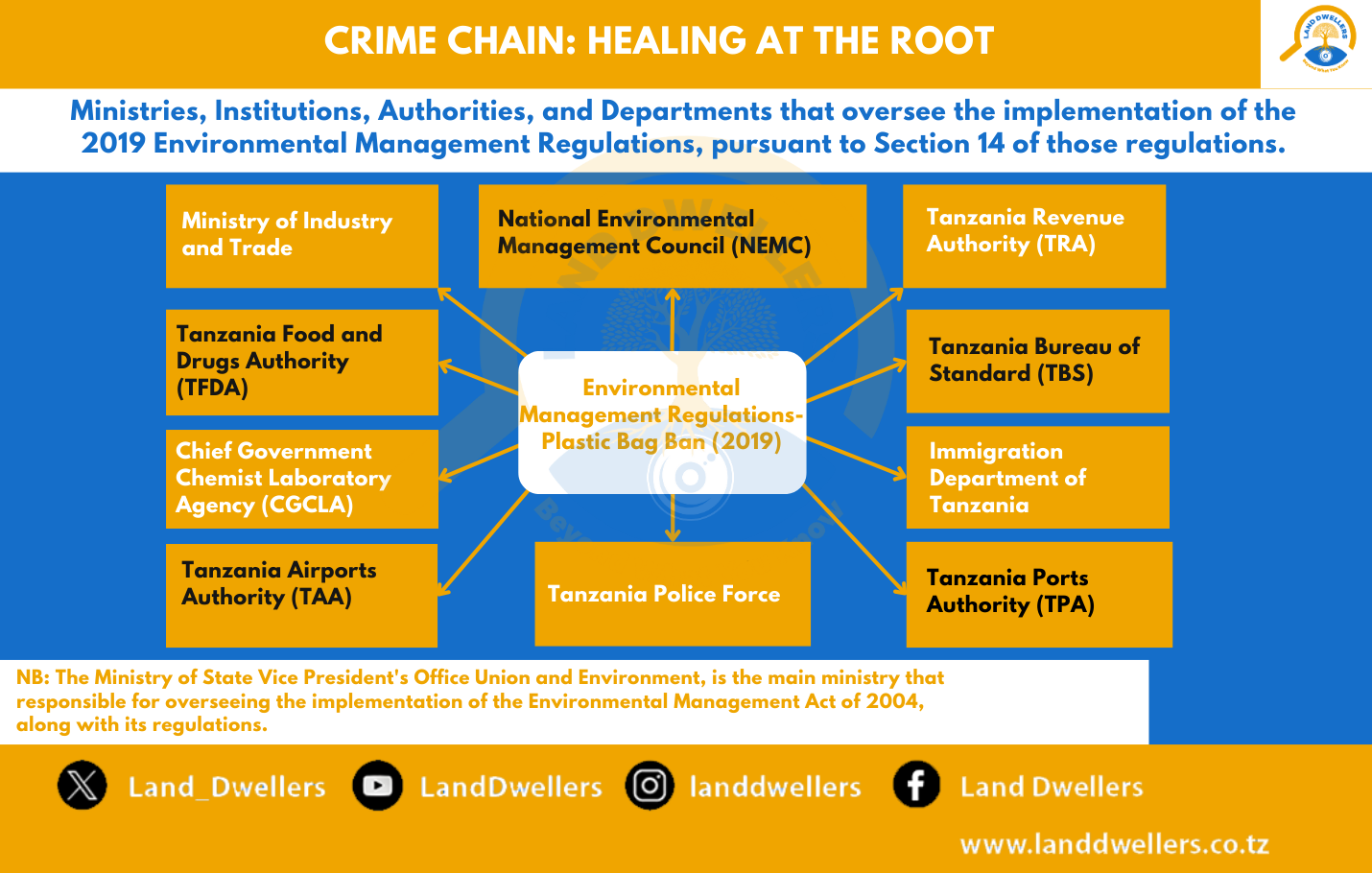
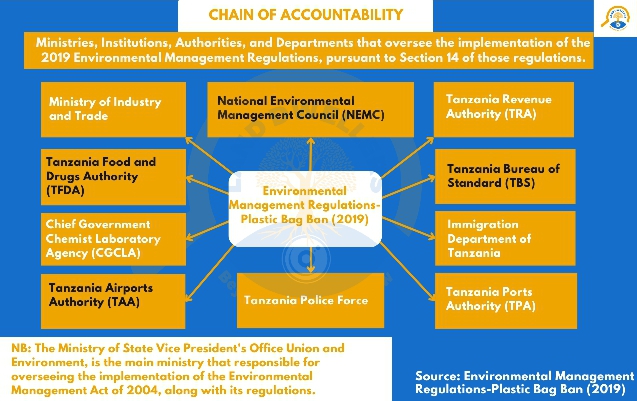
The Section 14 of the Environmental Management Regulations (2019) on the plastic bag ban mentioned ministries, institutions, authorities, and more than 10 departments involved in managing the plastic bag ban in Tanzania. According to these regulations, some of the ministries, institutions, and authorities include the Ministry of Industry and Trade, Tanzania Food and Drugs Authority (TFDA), Tanzania Revenue Authority (TRA), Tanzania Bureau of Standards (TBS) and the Immigration Department of Tanzania.
Other institutions and authorities include the Tanzania Ports Authority (TPA), Tanzania Airports Authority (TAA), Chief Government Chemist Laboratory Agency (CGCLA) and the Tanzania Police Force.
Author: Yohani Gwangway
Editor: Dominic Allen