
By Yohani Gwangway
Tanzanian government banned the production, distribution, sale and use of plastic bags in 2019, however, their use has rapidly increased in various areas of Mwanza City. In shops, markets, and restaurants, many people continue to use these bags, contributing to rising environmental pollution and posing a threat to public health.
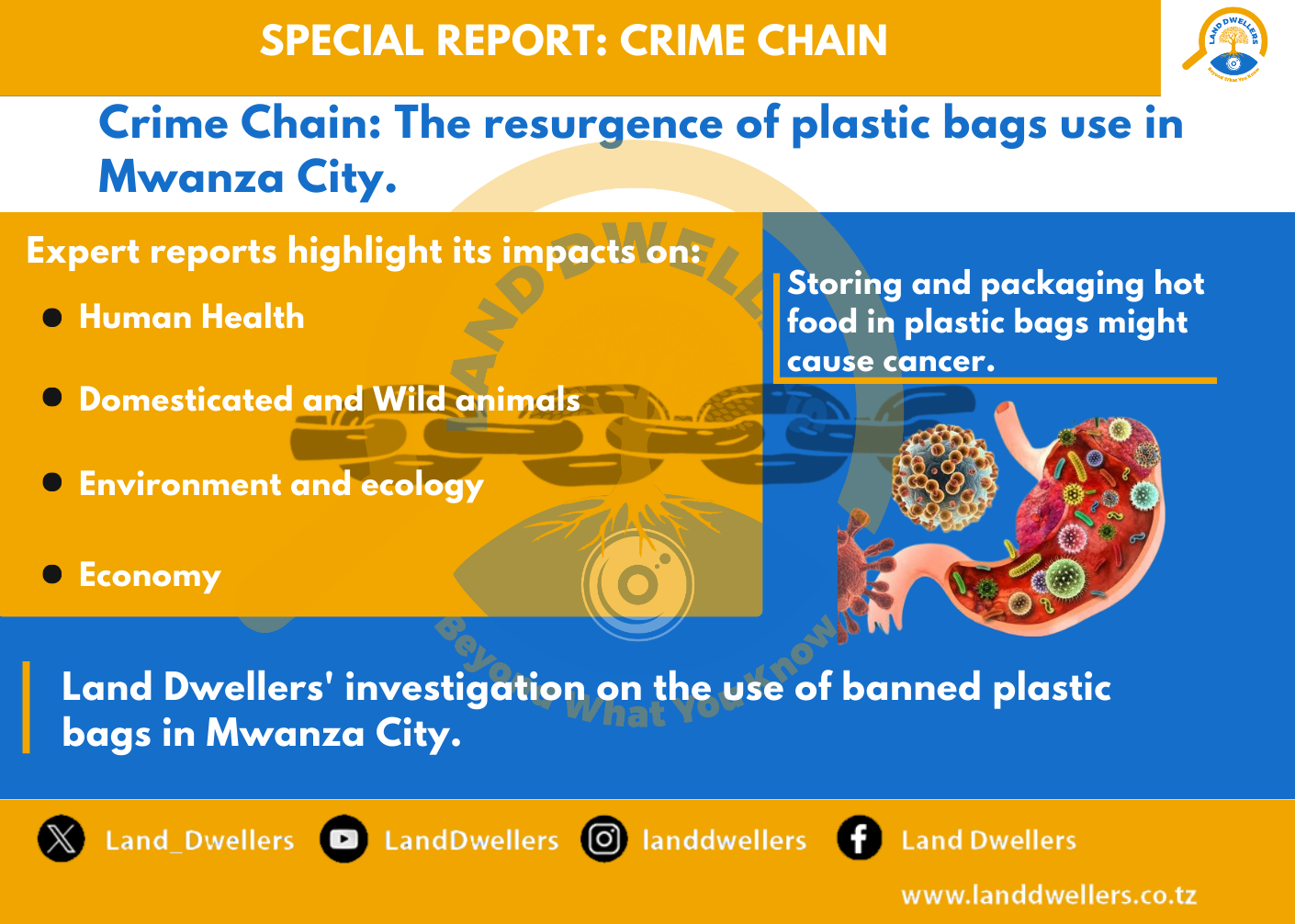
The use of these bags for storing hot foods has increased in various areas of Mwanza City. In the morning, food vendors in the city package chapati, dumplings, plums, and cassava while they are still hot. In restaurants, food vendors use plastic bags to store both hot and other types of food. Experts explain that this practice is dangerous to public health, as storing hot foods in these bags can lead to cancer.
This article highlights the uses and effects of plastic bags on public health, the environment, living organisms, and the economy.
Plastic Bags Production
The increase in the use of plastic bags in Mwanza City is a sign that there is production of these bags, either locally or abroad. Our investigation found that some of these bags are produced here in Tanzania in some factories, while others are imported from neighboring countries, especially Uganda.
Some of the businessmen interviewed in this article explained that those involved in plastic bag business mostly go directly to some neighboring countries, selling in the local market to get profit. Apart from being imported some of the local distributors reveal that there are local factories that produce these bags despite the government ban.
Section 5 of The Environmental Management Regulations 2019 (Ban of Plastic Bags), has set a prohibition to import, export, manufacture, sell, store, and distribute plastic bags due to their effects on the environment.
Jerome Kayombo, the Manager of the National Conservation and Environmental Management Council (NEMC) in Lake Victoria Zone, said that they have arrested one production factory in Mwanza. According to Kayombo the factory was in Kisesa, few kilometers from the city.
“Personally, I have arrested someone with a factory in Mwanza that had bags with the logo of some companies from Uganda. Therefore, concluding directly that these bags are imported from Uganda is not right, but those bags have the logo of Uganda. I say that because I have an experience that just happened in Kisesa, where someone has his own dumb factory and he has his own machines, and he puts the logo companies from Uganda” said Kayombo.
On the other hand, Kayombo said that people arrested for producing plastic bags and committing other crimes related to plastic bags were brought to court to face charges.
When asked if he has information that bags are imported from Uganda, he said he knows that there are people who break the law by importing these bags from abroad, but he cannot conclude that all the bags come from Uganda.
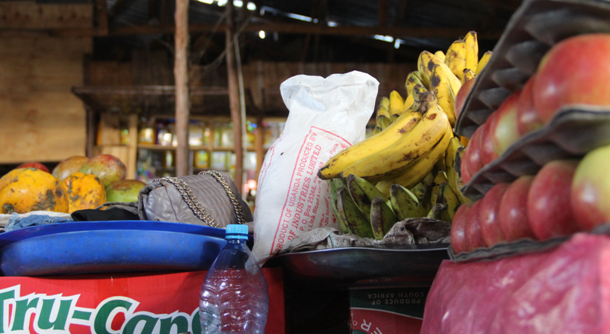
Our efforts to uncover the truth reached some Ugandan journalists, who were sent pictures and names of bag companies operating on the streets. They confirmed that some factories in their country produce these bags, proving that some of them are imported from Uganda. The bags with the logo are intended for industrial use only, as indicated by the label “for industrial use only.”
In recent years some of the businessmen who imported plastic bags were arrested in Mwanza. In 2021 the Police in Mwanza City seized a shipment of 40 sacks of these bags from Uganda. Later on, former Minister of State, Vice President’s Office (Union Affairs and Environment), Suleiman Jaffo, praised the Police Force and the Prevention and Combating of Corruption Bureau (PCCB) for arresting the businessman who imported that cargo from Uganda.
In 2024, another shipment of 80 sacks with more than 11 million plastic bags was seized in Mwanza city. Among the brands of companies that have been seized in Mwanza is PACHA Investment Limited, Twin Source Agro Limited from Wankulukuku, Kampala. Other bags appear to be produced by the company known as Toco and CO Limited from Tanzania.
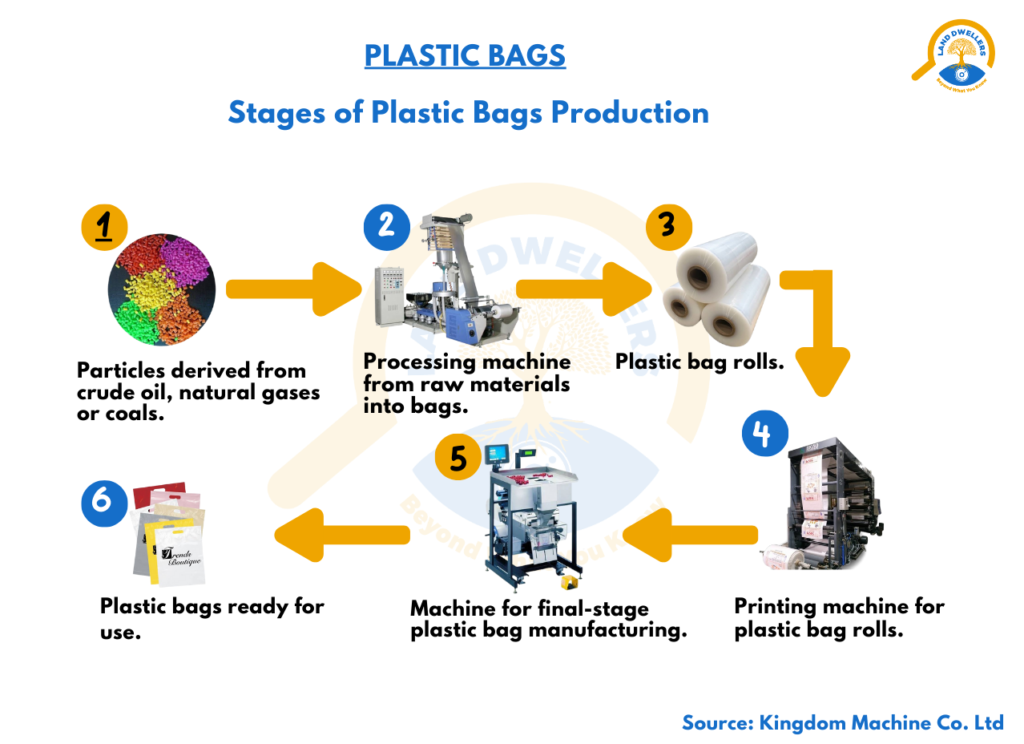
These are the stages of plastic bags production. The raw materials for the production are crude oil. Plastic bags production cause Ozone layer depletion and contribute to Global warming.
The International Union for Conservation of Nature (IUCN), in collaboration with the United Nations Environment Programme (UNEP) and the Life Cycle Initiative, released a report in January 2021 titled National Guidance for Plastic Pollution Hotspotting and Shaping Action that investigated the state of environmental pollution caused by plastic in Tanzania. The report shows that in 2018, 315,000 tons of plastic waste was produced in the country, and in that year, approximately 29,000 tons of plastic waste entered the seas, rivers and lakes in Tanzania.
According to the United Nations Environment Programme (UNEP), approximately 460 million tons of plastic are produced every year all over the world, with two-thirds of that production are short-lived, that they end up as trash. Among those plastic products are plastic bags.
Importation of Plastic Bags
Mwanza City seems to be easily accessible to all East African countries. A report titled Illegal Trade and Smuggling of Plastic Bags in the East African Blocreleased in 2022 by the Nipe Fagio Organization (Tanzania) in collaboration with Bio Vision (Uganda), Global Initiative for Environment & Reconciliation (Rwanda), and the Centre for Environmental Rights and Development (Kenya) showed that some of these bags are imported from Uganda.
How is the Importation Done?
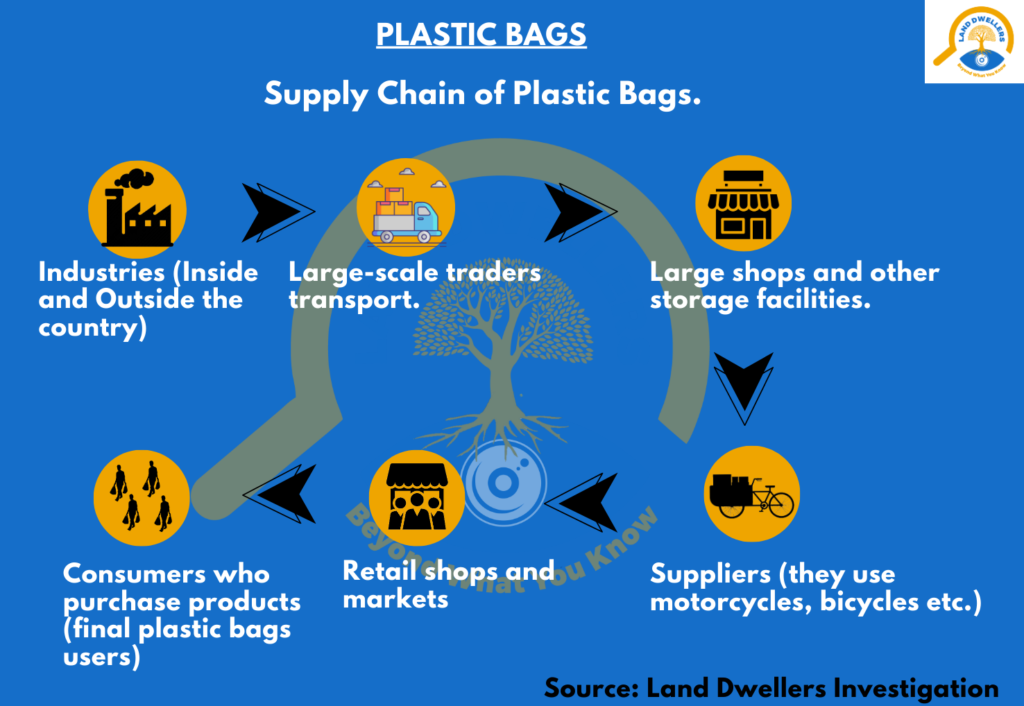
Land Dwellers has conducted a thorough investigation and identified the supply chain of the plastic bag business, from production to end users. The chain starts from factories, both local and abroad, that produce these bags. After that, they are taken by large-scale businessmen and distributed to storage facilities. These storage facilities include large shops, abandoned houses, or buildings under construction.
From these informal storage facilities, the chain goes to small-scale suppliers, who use bicycles, motorcycles, and backpacks to transport and distribute them in retail stores, local markets and on the streets. From the retail stores, markets, and streets, it goes to consumers who are the public.
For those who are buying some products in the markets, these bags are used as carrier. In the local restaurants locally known as ‘migahawa’, food vendors are using plastic bags for storing hot foods.
According to an interview with a local supplier, the bags pass through unofficial borders with neighboring countries. In some instances, businessmen import their cargo through Lake Victoria without the authorities’ knowledge.
The Lake Victoria Zone said that due to the geographical makeup of Mwanza City, some traders import these bags through the lake, making it difficult to distinguish between fishermen and law breakers.
“Our city has Lake Victoria, and there are many activities taking place in the lake. You cannot even understand sometimes; you can see a canoe and not knowing that it is carrying plastic bags” said Kayombo, NEMC Manager in Lake Victoria Zone.
How Plastic Bags are stored
Businessmen are using different techniques in storing bags that have already been imported into the country. They use hotels, residential houses, abandoned houses and buildings under construction as storage facilities.
While responding when asked about the techniques used by laws breakers to store these bags, NEMC Manager in Lake Victoria Zone Mr. Kayombo said;
“We have caught bags in houses; we have caught them in hotels. There is a hotel where we caught more than 40 loads. In another case, we caught bags in the compound of someone’s house, where there were guards. When you pass outside, you think the site is under construction, but at night people are doing business”
Despite this information from NEMC, our investigation and interviews with some distributors found that, in Mwanza City, Wholesale shops selling alternative carrier, are responsible for distributing plastic bags. Some of the businessmen in these shops hide plastic bags and pretend they are selling alternative bags that are allowed so that they are not easily discovered.
Sale and Distribution of Plastic Bags in Mwanza City
In Mwanza City, plastic bags are distributed from these Wholesale shops or places using multiple distribution method so as to reach to local shops and local markets. Some of these ways are distributing by motorcycle, using bicycles and backpacks. Some of the backpack suppliers are not easily caught since they act as if they are supplying other products in the streets.
Interviews conducted with the local supplies especially those who are using bicycles revealed that these suppliers are some of whom distribute bread and home products. These suppliers are important link between the wholesaler’s shops and local shops or even local markets. Ahmed (not his real name), is a distributor who uses bicycles to target buyers who have local shops. He said that they are easily doing the business because they are known to the wholesalers in the city.
“I am the one taking the bags from the wholesalers in the city. The vendors in town know us, and they know we are suppliers. If they see a new face, they can’t sell. Most shops are the ones that sell alternative bags or store other products” said Ahamed , a local supplier.
In Mwanza City, plastic bags are sold openly, carried, and sometimes seen in public places. The users who were interviewed said that the bags are sold and distributed by people using bicycles or motorcycles.
“We buy these bags from those who are using backpacks. You find that others have bicycles and some have motorcycles. If we don’t find from them, we go to the shops” said Amina, a food vendor at Nyamalango.
These techniques are changing day by day. Other techniques include using of private cars, boats, passenger buses and special vehicles for shipping.
“We have seized bags on buses, in cars while they are being transported. We have caught bags in fish trucks, you might think it’s fish, but there are bags inside. We have caught boats. What I am telling you is that the techniques are not the same; they are so many, that is why we need cooperation.” The Lake Zone NEMC Manager, Kayombo explained.
Uses of Banned Plastic Bags in Mwanza City
After these bags enter the markets and local shops, they are no longer for sale but are used as carrier bags or for packaging different products. In the local markets, they are used for carrying grain products, fruit, or other products, while in local shops they are used in packaging different products like sugar, oil, groundnuts and so forth.
Despite the government ban in 2019, the use of banned plastic bags in Mwanza City is not something in hide. In markets, shops, and restaurants, these bags seem to be scattered. The interviews we conducted with residents reveals that the authorities are not concerned with the use of plastic bags since they are seen everywhere. Rajabu Khamis is a resident in Buhongwa, he explains the places where these bags are used.
“I see these white bags very often. But the black and blue bags are not visible for now. The places where I see these white bags (transparent plastic bags) are places like shops where you buy something; other places are local restaurants where they use the plastic bags preserve the temperature of the food.” Rajabu explained.
Plastic Bags uses in Mwanza Local Markets
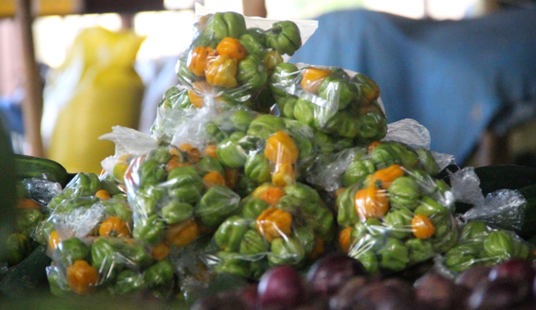
In the big markets of Mwanza City, like Kirumba Market, Buhongwa and Mirongo, the use of plastic bags for packaging still at large. These bags are used for various products in markets such as tomatoes, fruits, and grains of different kinds.
Land Dwellers conducted several interviews with the businessmen and vendors in these markets where it was observed that most of the businessmen and vendors are not aware of what kind of plastic bags are banned. Mariam Said, a fruit vendor in Buhongwa Market said that the transparent plastic bags are not banned
“I don’t think these bags are prohibited. We stopped using the banned bags, and right now we are using these “Magufuli bags” (alternative bags) together with these transparent one which are used for packaging” said Mariam.
8 businessmen and vendors out of 10 who were interviewed in Buhongwa market seemed that they are not aware of the negative impacts of using plastic bags. On other hand few residents seemed to know that the plastic bags were banned but they are using them because they are free and available.
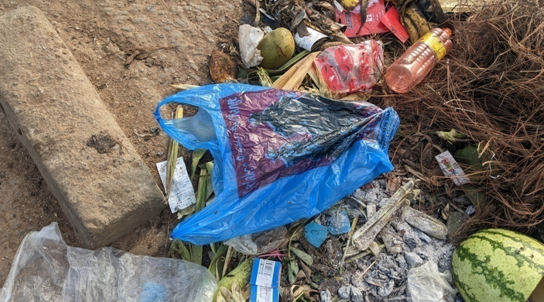
In the morning hours, when cleaning takes place in market areas, Land Dwellers observed plastic bags among the waste. Blue plastic bags, which are usually hard, were also seen. These bags are commonly known as “Malboro” or “Rambo” by most people.
This investigation wanted to know if these bags are still in use. We interviewed Buhongwa Market Chairman, Sylvester Kadoya Makoye, to find out why there is a use of these bags in his area.
“Personally, I can only say that I cannot prevent it because the bags exist and are being used now. I don’t know where these bags come from, but the vendors are using them here. I think the government should stop the production, if not, as much as the bags is available, the vendors will use them.” Answered Makoye.
Plastic Bags in Local shops
In various shops in Mwanza City, plastic bags are widely used. In 50 local shops visited by Land Dwellers as part of the investigation, plastic bags are available in 45 shops. This means that 90% of local shops are supplying plastic bags.
For shop owners or sellers, these bags are used for packaging various products such as peanuts, soap, rice, flour, beans, oil, and others. In their interview with Land Dwellers, most of the shop owners said that they are aware these bags have been banned, but they claimed they use them because customers need them since they’re free. The alternative bags are not free.
“The truth is that many customers prefer to use the plastic bags because they know that even if they don’t have money for the bag, their products will be packed in these bags for free. This factor attracts customers, that’s why I use it” said a shop owner, who was not willing to be named.
In several interviews conducted to the residents in Mwanza City, it was clear that the authorities are not taking proper action in enforcing the laws. As the result, the banned plastic bags are in all public places.
“These bags are used in shops, markets, and restaurants. If you go to the market, they are used for packaging. For example, if you go to the market to buy tomatoes, they are pack in these bags. If you go to local restaurants, the food vendors are using them to preserve the hot food like Ugali. If you go to the local shops, they pack products like rice and so on.” Commented Lilian Jones, a resident of Buhongwa.
How Plastic Bags are Used in Local Restaurants in Mwanza
For the residents of Mwanza City, Ugali is one of their favorite foods. Some of the biggest consumers of Ugali are people who perform intensive tasks. Due to the fact that some of them do not eat on time, the Ugali needs to be kept hot for a long time.
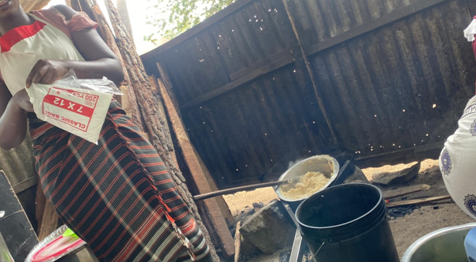
The use of plastic bags is now widespread in local restaurants in Mwanza. Many food vendors in these restaurants use plastic bags to store food to keep them from getting cold. In many streets of this city, this is one of the alarming uses of plastic bags.
“Here I wrap Ugali to keep it warm. I do this so that the Ugali does not get cold. When I finish, I put hot water in the kitchen in another pot. It means that even when the customer arrives, he finds that the food is still hot.” explained the one of chefs at Nyamalango.
In an attempt to understand whether food vendors are aware of the effects of using plastic bags in storing hot food, most of them do not have any knowledge about health problems associated with this.
“Aaah, I really don’t know the effects, I don’t know the effects” said one of the food vendors.
Land Dwellers tried to seek comments on this use from experts and law enforcement authorities. The Mwanza City Health Officer, Audiphace Sabbo said that they are struggling to raise public awareness about the matter while holding accountable those who continue to use these bags.
“As the Mwanza City Council, we at the Health Department prevent the use of plastic bags as banned by the government. It is true that despite this ban, there are still naughty people who still use these bags. As I said, our job as professionals is to ensure that they are not used. Therefore, we always take action if we find it in the market or if we find food vendors who are using plastic bags. We take them and destroy” said Audiphace Sabbo, Mwanza City Health Officer.
Effects of Using Plastic Bags
Plastic bags, made from crude oil (crude oil), cannot be recycled for reuse. The effects of using these bags can be divided into four main parts which are environmental effects, health effects for humans, impacts on living organisms, and economic impact.
Impact on the Environment
Plastic bags in Mwanza City seem to litter and pollute the environment, especially in market places, near the Lake, and in some sewage systems. The disposal of these bags after use makes the environment unattractive to visitors or tourists who arrive in this city for the first time.
Some residents of Mwanza, who were interviewed, explained how dirty the environment is due to the disposal of plastic bags after use.
“In our environment, in water sources you find plastic bags. If you go to the lake, you will find it; in the ditches, you will find it blocked. So it is environmental pollution because it is scattered everywhere” said Lilian Jones, a resident of Mwanza.
The publication of the National Environment and Management Council (NEMC) of the year 2023, with the headline “Prohibition of Plastic Bags and Alternative Bag Usage Status,” explains that plastic bags can last for 400 to 1000 years to rot in the ground.
According to UNEP and IUCN in 2018, 315,000 tons of plastic waste was produced in Tanzania, with approximately 29,000 tons of plastic waste entering the seas, rivers, and lakes of Tanzania that year. In Mwanza City, Lake Victoria is mainly affected due to fact that many rivers washing away plastic waste and sending it to the lake.
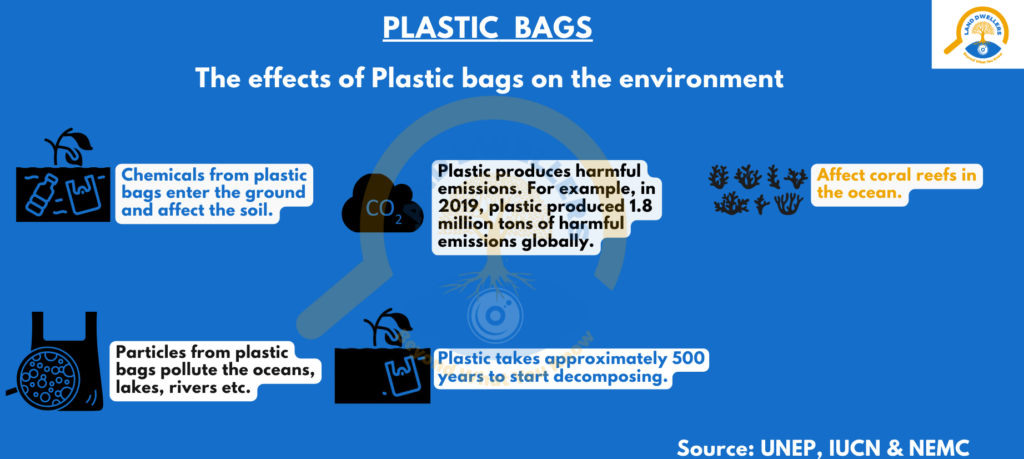
In some areas of Mwanza City, these bags have been thrown into rivers and canals, which can cause the blockage of canals and other waterways. The Mirongo River which flow to Lake Victoria, plastic bags can be seen floating, and some are carried to the lake.
The NEMC Manager in Lake Victoria Zone said that the community needs to understand the effects of these actions, which will eventually affect them too.
“The first thing that most people need to understand is that plastic bags do not rot. If you produce a plastic bag today, it may take years until it is completely gone — 200 to 300 years. In that sense, it will remain in the environment.” The Lake Victoria Zone NEMC Manager, Kayombo explained.
How Plastic Bags can endanger Living Organisms
Plastic bags that have been thrown into the environment have had various effects on land creatures as well as aquatic creatures. The website of the National Environmental Management Council (NEMC) states that these bags also affect marine ecosystems, where an estimated 100,000 sea creatures and sea birds die every year from eating plastic bags around the world.
Some studies show that plastic bottles and plastic bags, when entering water sources, are also eaten by fish, which are later consumed by humans. A study named First Evidence of Microplastics in the African Great Lakes: Recovery of Lake Victoria Nile Perch and Nile Tilapia (2015), conducted by researchers from Sokoine University, University of Dodoma, the National Museum of Denmark, and Roskilde University, noted that one in five fish in Lake Victoria have plastic particles in their intestines.
For Nile Perch, 55% of the researched fish showed particles of plastic bags. Studies of the effects of these particles on humans are still ongoing, according to NEMC.
As the Mwanza City located on the edge of Lake Victoria, threatens the safety of aquatic species, especially fish, due to the use of plastic bags that are often washed away in the water and carried to the lake after use. According to NEMC, these bags affect coral reefs, which are a habitat and breeding ground for fish.
“In the lake, there are fish, there are frogs, there are crocodiles and there are plants, there is everything. All of that is created and its nature should not be disturbed. Now, if it happens that you have sent plastic bags that don’t rot, like that, where the fish are looking for food, it means they can’t find food again. If that area are breeding ground for the fish, it means they cannot spawn again” explained the Lake Zone NEMC Manager about the harm to living organisms and the ecology in general.
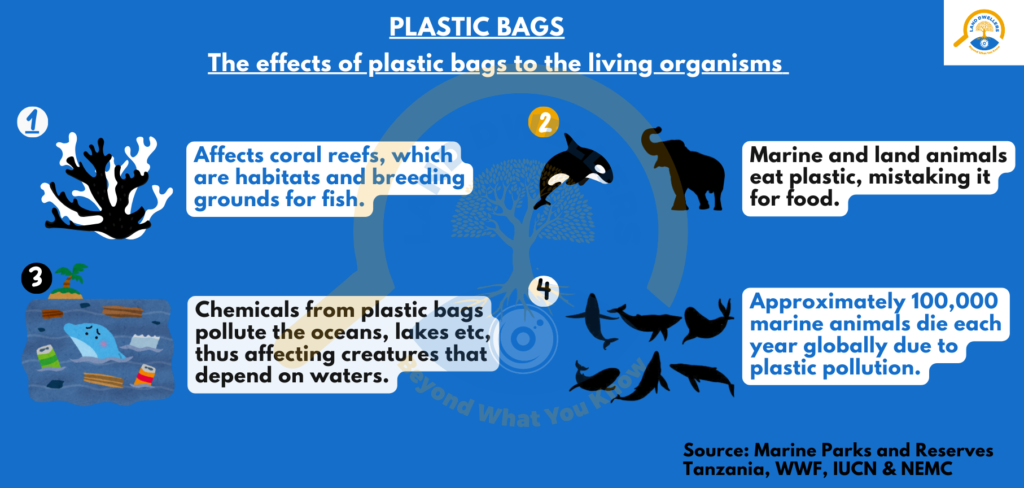
There is evidence that the world loses 100,000 aquatic animals every year due to environmental pollution. Among this pollution is plastic waste.
Effects of Plastic Bags on Human Health
Various studies show that plastic bags have an impact on human health, especially when they are used to keep food warm, carrying hot food and sometimes when burned, they are producing harmful gas that affects the human respiratory system.
Various experts continue to research the effects of these bags, but for now, some have suggested that there is a possibility of a person getting cancer if they eat food stored in these bags.
“The effects of plastic bags are very serious. One of them is cancer, where humans can get cancer, which is why we ban the use of these bags in food packaging and other product packaging” said Audiphace Sabbo, Health Officer, Mwanza City.
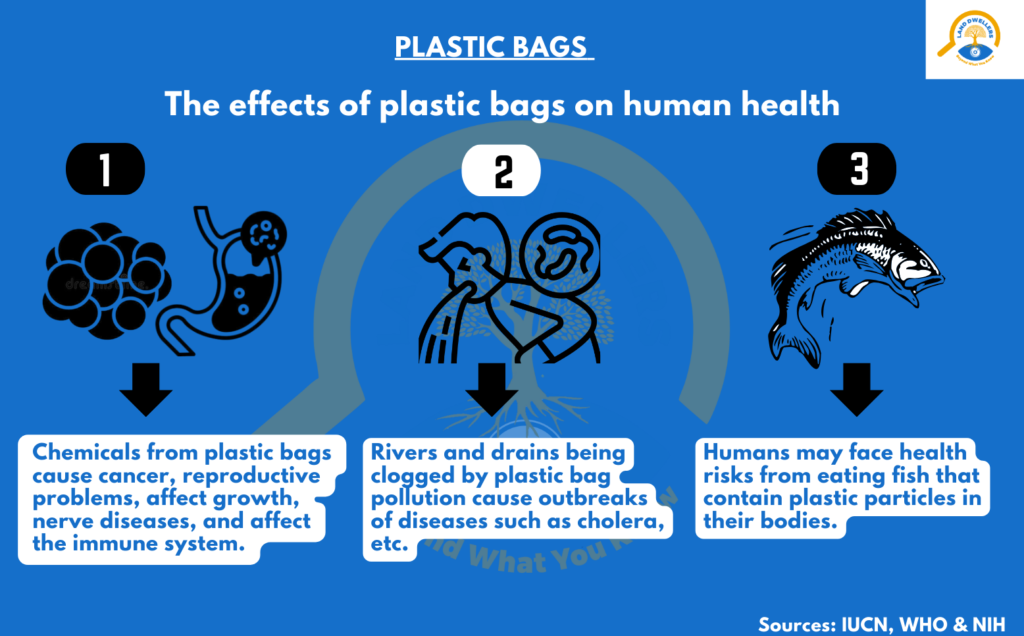
Health experts say that these bags are easy to carry and spread invasive species and bacteria. According to the National Environmental and Management Council (NEMC), this is one of the effects of using these bags and abandoning them to the environment. If they are thrown carelessly, these bags can spread bacteria. Studies have shown that when burned, their smoke is harmful, containing carcinogenic compounds. The bags also contain chemicals like polychlorinated biphenyl, styrene, and bisphenol, which can cause cancer to humans. This is stated in the NEMC Journal of August 02, 2023, entitled ‘Prohibition of Plastic Bags’.
Due to the fact plastic bags take long time to rot, their disposal in drains causes clogging in canals, where the presence of dirty water leads to stomach diseases, including cholera. This is according to the National Institutes of Health (NIH) in the United States, in their 2024 publication.
Fish containing plastic particles, when eaten by humans, can cause health problems. However, this issue has not been fully clarified by scientists, and various studies are still ongoing.
Economic Cost of Plastic Bags
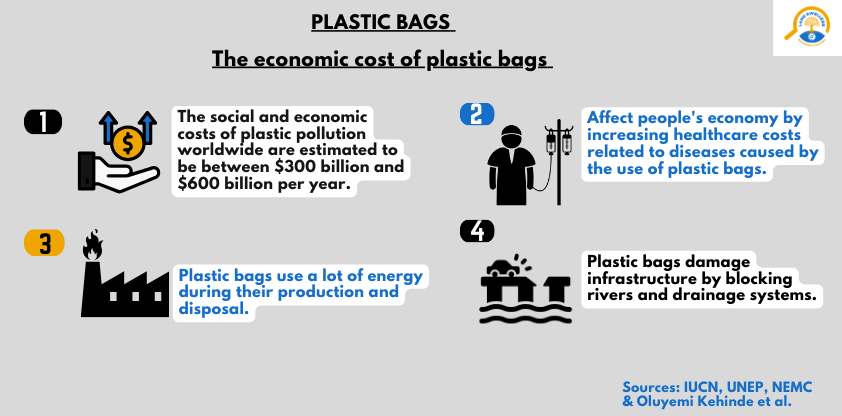
Plastic bags are provided free of charge to consumers who buy products in the markets as well as in the shops. For this reason, many people believe that these bags have no cost. In reality, the costs of these bags can be seen by evaluating their effects on the environment, livestock, humans, and even the raw materials used for manufacturing them.
18 Mwanza residents out 20, who were interviewed, did not understand the economic impact, saying that these bags are given for free, so they do not pay any money. Only a few mentioned that they believe these bags are polluting the city and affect tourism activities.
Environmental experts argue that there are economic effects of using these bags, including damaging land quality, killing animals that are economically important, and the costs of cleaning up when waste accumulates.
“When a plastic bag gets into the land, it cannot allow anything to penetrate. If it stays in the field, it means the farm has lost its quality and suitability for agriculture. Therefore, the harm is in agriculture, in livestock, and there is general pollution.” Lake Zone NEMC Manager explained about the economic consequences.
Several studies have been conducted to examine the economic effects of using plastic bags. The disadvantages appear to outweigh the advantages. The diagram below illustrates the economic impacts of using these bags.
Author: Yohani Gwangway
Editor: Dominic Allen