
By Dominic Allen
Survival of all living and non-living organisms depend on presence of clean air in their surrounding environment. On November 26, 2019 the United Nations General Assembly designated September 07 as the International Day of Clean Air for Blue Skies.
The aim is to emphasize and raise public awareness at all levels about the significance of clean air to humans and other living creatures. Without a doubt, a world without clean air is just like an abandoned building that might collapse at any moment.
“Invest in Clean Air Now,” is a 2024 theme for this important day that we celebrated on September 07. While we are thinking about clean air globally, it’s important to ask where we came from, where we are, and where we are heading.
Air Pollution
Air pollution has been a pressing global issue in recent years. In 2019 the World Health Organization (WHO) reported that 99% of the global population lives in areas where WHO air quality guidelines levels were not met.
WHO adds that air pollution leads to premature deaths, with approximately 6.7 million people dying annually because of air pollution.
The primary sources of global air pollution are divided into two categories. The first category includes air pollution caused by human activities, such as transportation activities; emissions from vehicles, industries, and chemicals production.
The second category comprises natural sources of air pollution, like wildfires, volcanic eruptions, and gases such as methane from decaying organic matters.
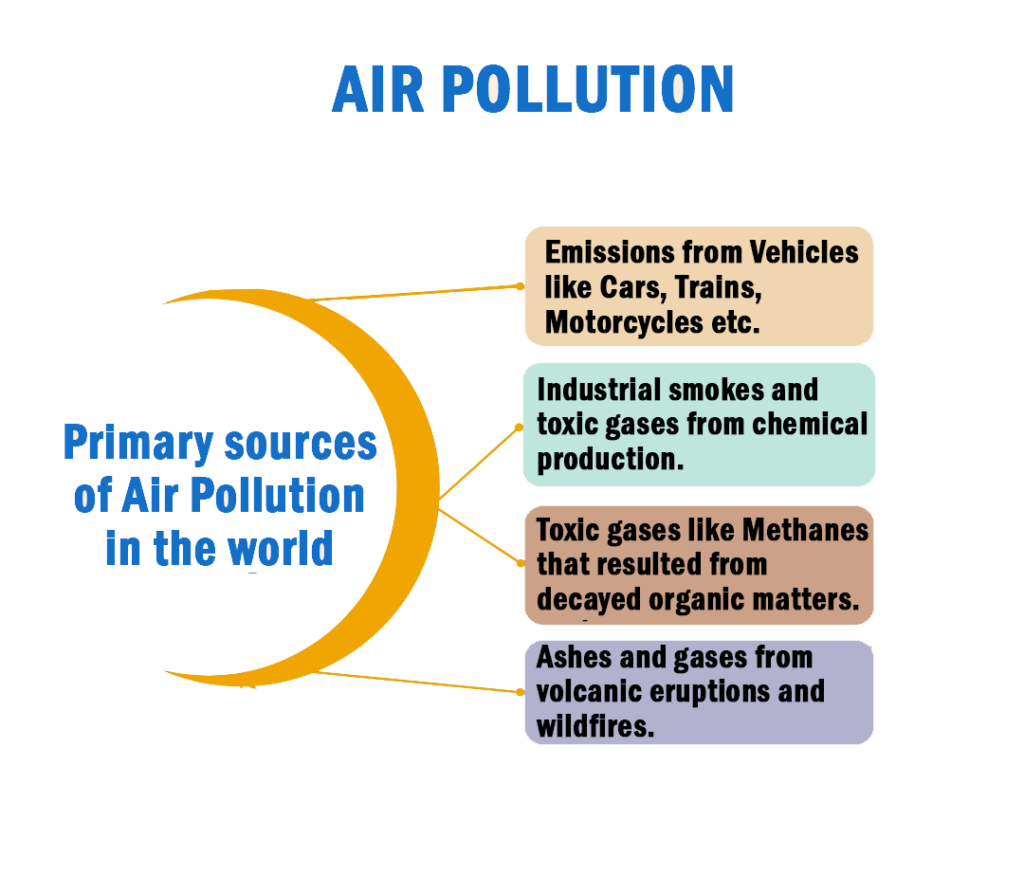
Primary sources of Air Pollution in the world.
The Impact of Air Pollution
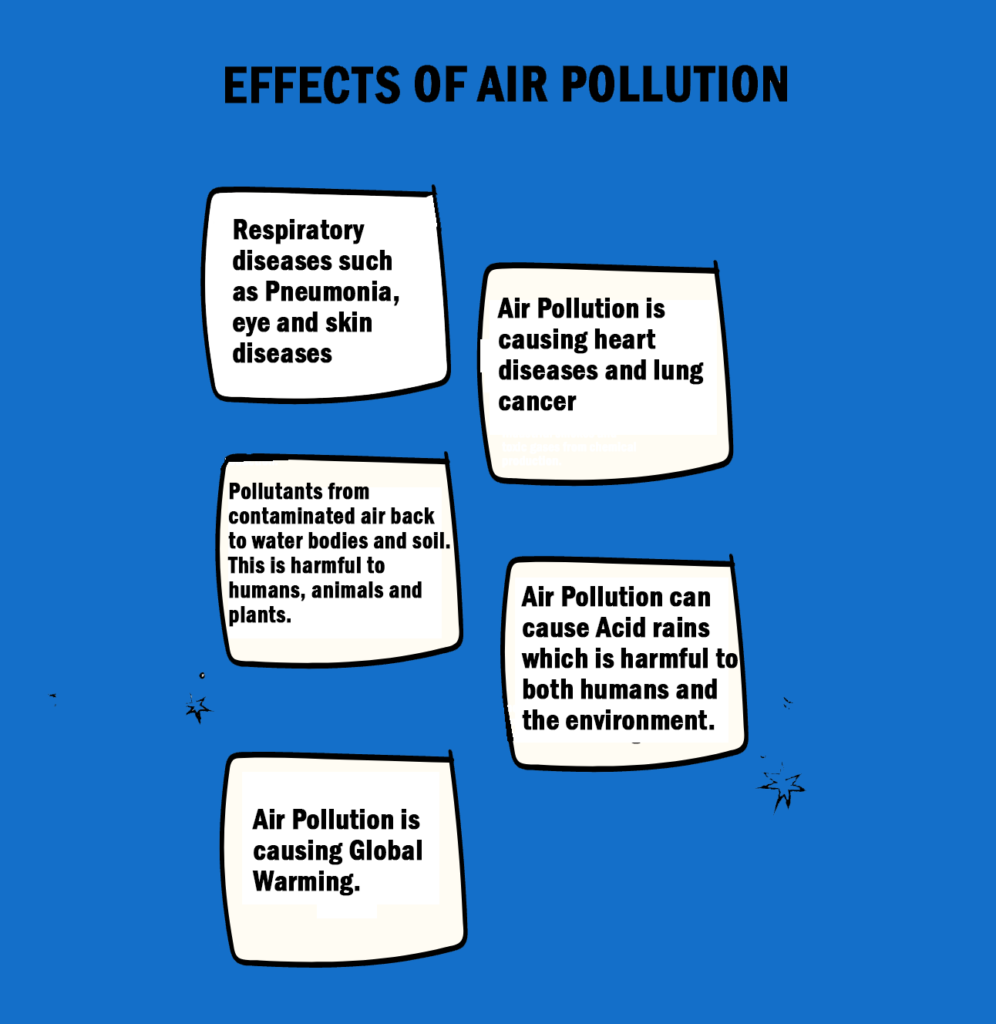
Air pollution affects not only to people but also to animals and the environment in general. Respiratory diseases such as pneumonia, eye and skin conditions, and even heart diseases and lung cancer are the effect of air pollution to humans.
According to the 2021 State of Global Air (SoGA) report released by Health Effects and United Nations Children’s Fund (UNICEF), approximately 8.1 million people worldwide died because air pollution. In 2021, 700,000 children under the age of five lost their lives because of polluted air, highlighting the severe consequences of air pollution globally.
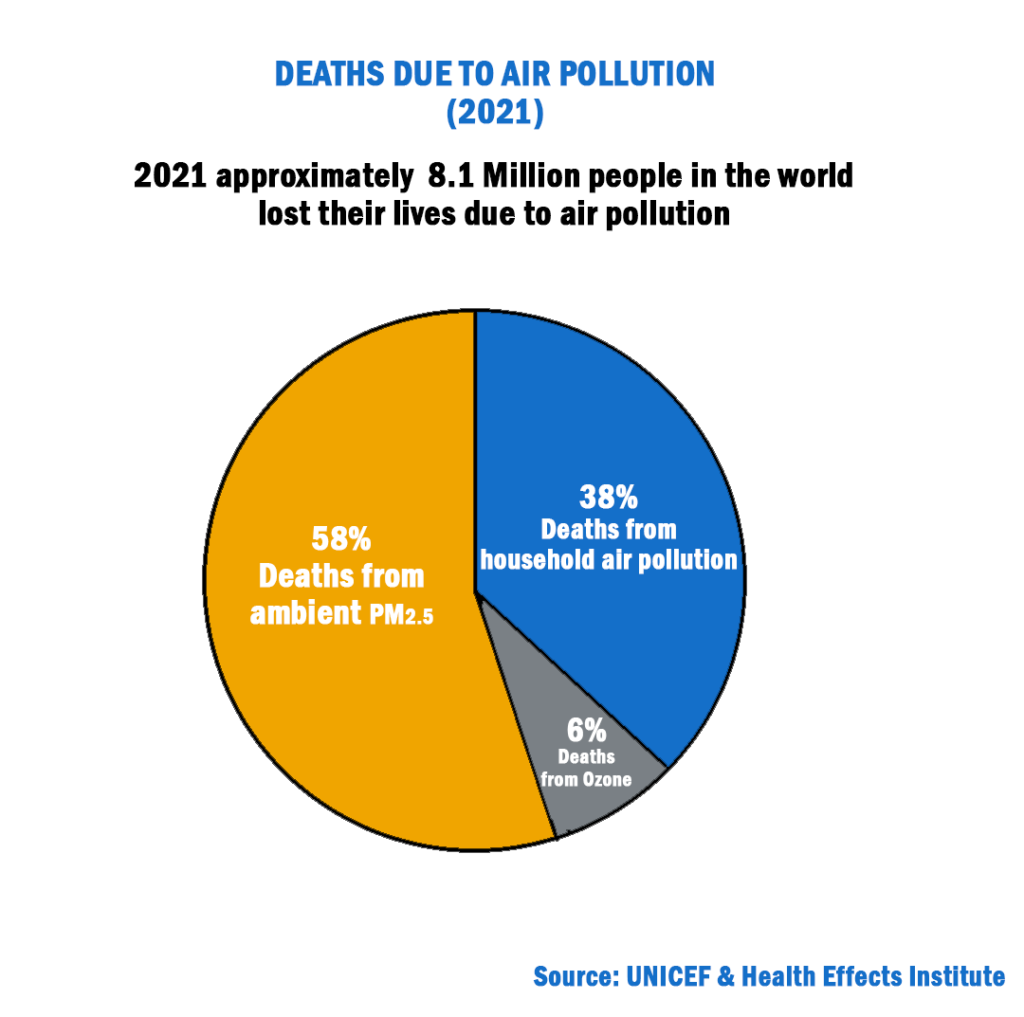
According to UNICEF & Health Effects Institutes, there were 8.1 Million deaths globally because of air pollution.
Effects of Air pollution know no boundaries, animals, plants, and ecosystems all are affected. Pollutants from contaminated air back to the soil and water sources, affect aquatic life and plants and other land living organisms.
Sulfur dioxide and Nitrogen oxide particles in the air when mixed with water and oxygen might cause acid rain, which is harmful to both humans and the environment.
Global warming itself, which poses great challenge to the world, is partly caused by air pollution.
Global efforts to combat Air Pollution
All around the world they have working hard to combat air pollution so that to conserve the environment for the benefit of all.
In 1997 Kyoto Protocol was established, this is an international agreement aimed at protecting the environment for the sake of our future. Although 192 countries have signed the agreement, some of nations like the U.S. and South Sudan have yet to do so.
Many countries in the world have passes Laws and Regulations to regulated activities causing air pollution.
In 2006, WHO introduced air quality guidelines to minimize air pollution-related deaths by 15%.
Sustainable Development Goals (SDG) have direction connect with Clean Air; SDG Number 03 – Sustainable Good Health and Well-Being, it is clear that in order to achieve this goal, we have to fight against air pollution which is the reason for diseases including respiratory disease, eyes and skin diseases.
SDG Number 11 – Sustainable Cities and Communities, to reach it there is no doubt that each country must set Laws to regulate all activities causing air pollution, especially in urban areas.
Situation in Tanzania
In Tanzania, air pollution remains a big challenge, especially in urban areas where emissions of toxic gases like Carbon Monoxides from vehicles and industries contribute a lot to air pollution.
Domestic activities, such as using of charcoal and firewood as source of energy, also play a major role in polluting air without forgetting wildfires which still pose challenge in this fight against air pollution.
Poor waste management from industries leading to water pollution which eventually evaporate to the sky hence the risk of having unsafe rains water.
The 2021 National Environmental Policy of Tanzania envisions a “sustainable, safe, and clean environment,” but to achieve this, we cannot ignore the issue of air conservation.
National Environmental Policy of Tanzania on its first chapter section 1.2.6, confirms that environmental pollution has negative impacts not only to the land and water but also on the air something affecting humans and environmental in general.
As nation we have vision of extracting oil and natural gas, and we have been dreaming of this since the discovery of natural gas in Songo Songo Island in 1974 following another discovery natural gas in Mnazi Bay in 1982.
In 2004 and 2006 production of natural gas in Songo Songo and Mnazi Bay started. This is so promising, but we need to ask ourselves; How prepared are we on conserving our environment while conducting such activities.
National Environmental Policy said that oil and natural gas production in Tanzania face challenges on controlling air pollution caused by oil and natural gas production.
Simply to say, if we cannot manage such production we should expect negative impacts to the environment including air pollution; this will be a curse not a blessing at all.
The policy’s objectives is to prevent environmental pollution so that to have healthy and good environment. Responsible authorities must go through their plans and strategies to ensure those objectives are achieved.
In Tanzania, Environmental Management Act (2004), Chapter 5 on Section1 (a) says a Minister has mandate to command an investigation on all activities that causing the Ozone layer depletion which affects public and environment.
On Chapter 8 of Environmental Management Act – Section 4 restrict any activities that causing air pollution beyond the required level which is provided by the Act.
To fight against environment pollution in Tanzania, the Act set punishment to those who will be found guilty of polluting the environment; Fine of not less 3 Millions TSh and not more than 50 Millions TSh or imprisonment of not more than 12 years or both. Is it enough in this fight against environmental pollution? Public awareness is required so that to go along with global changes.
Although the Environmental Management Act has assessment plans on the negative effects of waste yet much more efforts are required to control air pollution in our country.
Tanzania and International Treaties
Tanzania, like other countries, is striving to ensure that the future of its environment is safe. To achieve this, it has signed several international environmental protection treaties.
Vienna Convention (1985), Tanzania signed this convention which it primary goal is to protect the Ozone Layer. This convention aims to facilitate cooperation among member countries in sharing information on research about ozone layer depletion for the sake of today and future generation.
Tanzania also is a member of the Montreal Protocol, which seeks to regulate the chemicals that deplete the Ozone layer.
Tanzania must pass through its plans and strategies on regulating and controlling air pollution, are they good enough to reflect the agreements on those International Conventions?
Chemical productions in Tanzania lead to air pollution, to control the impacts of such activities, Tanzania is a signatory to the Stockholm Convention on Persistent Organic Pollutants (POPs), aimed at controlling long-lasting chemicals in the environment.
Through this convention cooperation between Tanzania and other nations has been improved, though the lack of awareness in the community about long-lasting chemicals in the environment is an obstacle to reach our goals.
Enhancing public awareness at individual to national level is required so that we tackle air pollution.
Reaching the Promised Land
Air pollution has become a bad dream not only to Tanzania but also to the whole world. In order to address it, Tanzania needs to do the following;
First, improving public transportation so that to minimize the emission of toxic gases from moving vehicles, as toxic gases like Carbon Monoxides are likely to cause air pollution.
Second, controlling of industrial waste; the responsible authorities must take this seriously as poor waste management can lead to the contamination of source of water and soil, eventually they both have impact on the air. Laws and Regulations as well as Policy must play a role to ensure there is a proper industrial waste management.
Third, responsible Authorities for the conservation of the forest such as Tanzania Forest Services Agency (TFS) must ensure there are low cases of wildfires as well as proper punishment are given to those who found guilty of causing wildfires.
Fourth, improving social services; as the use of charcoals and firewood as source of energy play a major role on air pollution; peoples’ lives have to be improved at individual level so that they can shift to clean energies like gases etc to minimize air pollution.
Policy, Laws, Regulations plus International Conventions that our country already signed cannot take us to the Promised Land if there will be no accountability at individual level to the national level.
Every citizen has to be an ambassador on the issues concerning environment by understanding the importance of clean air; without clean Air, all of this will be for nothing.
Writer: Dominic Allen
Editor: Yohani Gwangway